Partnachklamm cut 80 metres down through Bavarian limestone
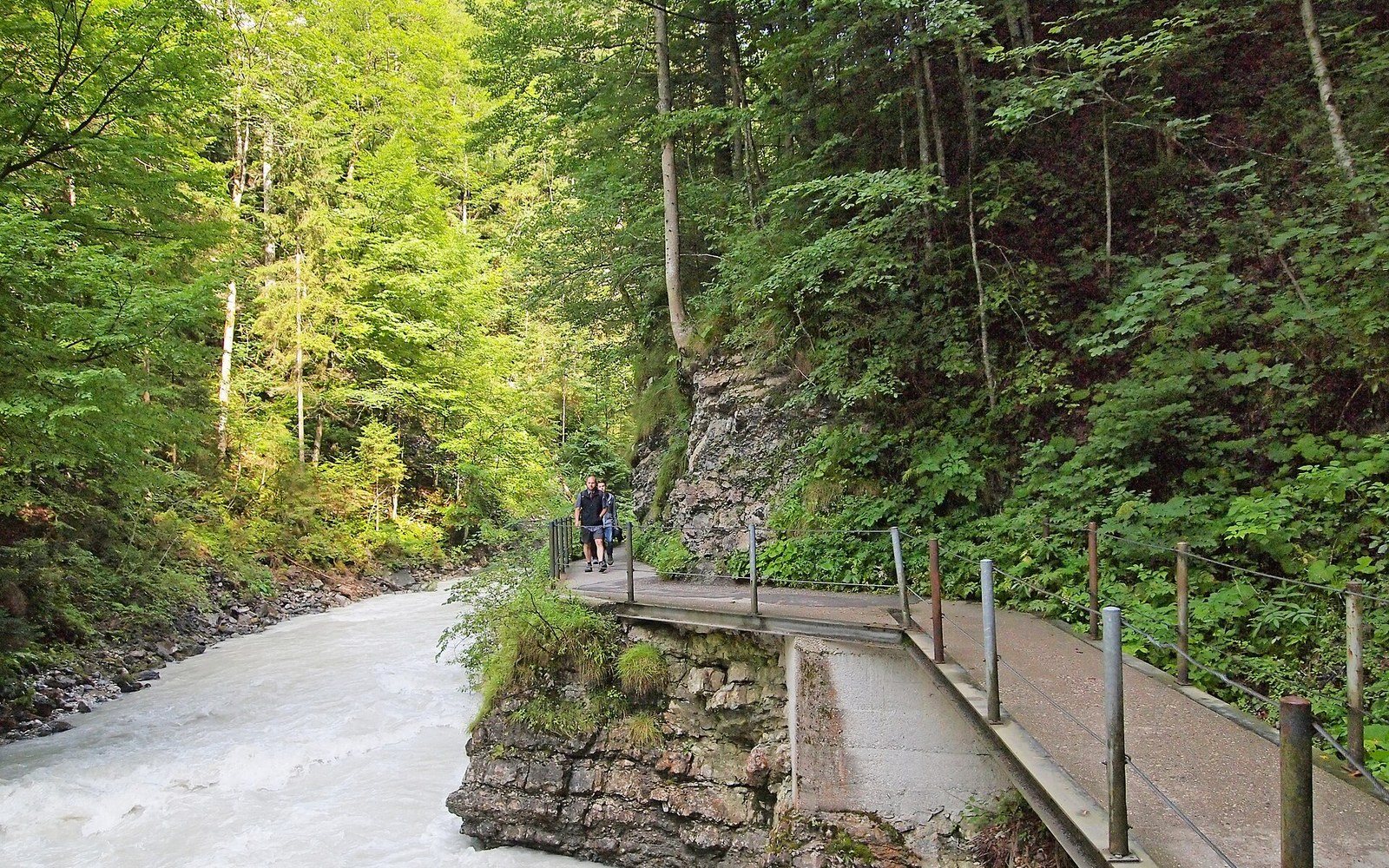
A narrow limestone gorge with water below and a cut walkway along the wallPhoto: Walkway to Partnachklamm · Wikimedia Commons
The Partnach river has been cutting into limestone below Garmisch-Partenkirchen for long enough to leave walls that shut out the sky.
The gorge and the path along it
The Partnachklamm — Klamm meaning a narrow rock gorge — is roughly 700 metres long and in places nearly 80 metres deep, with walls close enough overhead that daylight arrives as a strip. The Partnach river runs through the floor of it, fed by snowmelt off the Zugspitze massif and, in high summer, fast and green with rock flour ground by glacier ice ↗ suspended in the water.
A walkway has been cut and blasted into the gorge wall, following the river from end to end. In the narrowest sections the path is tunnelled through the limestone itself, and water seeps through the ceiling year-round — visitors in summer emerge damp. The gorge stays navigable in winter too, when ice columns build on the walls and the meltwater drop reduces the river to something quieter; the path is then lit artificially for much of the day.
The infrastructure here is maintained by the town of Garmisch-Partenkirchen, and access has been formalized since the early twentieth century. The gorge sits at the mouth of the Reintal, the broad valley that runs south toward the Zugspitze, and the river that carved it drains directly into the Partnach plain below the town.
Limestone this soluble cuts relatively quickly in geological terms, and the Partnachklamm shows the full range of what moving water does to it: smoothed potholes in the riverbed, undercut ledges, and sections where the walls are no more than a few metres apart at the top but flare outward below, giving the gorge a bottle-shaped cross-section. The Zugspitze massif ↗ above is built of the same Wetterstein limestone, a Triassic formation that dominates the northern face of the Bavarian Alps and weathers characteristically into grey towers and pale scree.
A walkway has been cut and blasted into the gorge wall, following the river from end to end
The walkway is not a natural trail; it required engineering, and the gorge walls still need regular inspection and maintenance after frost and flood. What a visitor stands inside is both a geological process and a piece of civil work cut to follow it.