Two thousand metres of east face separated Watzmann
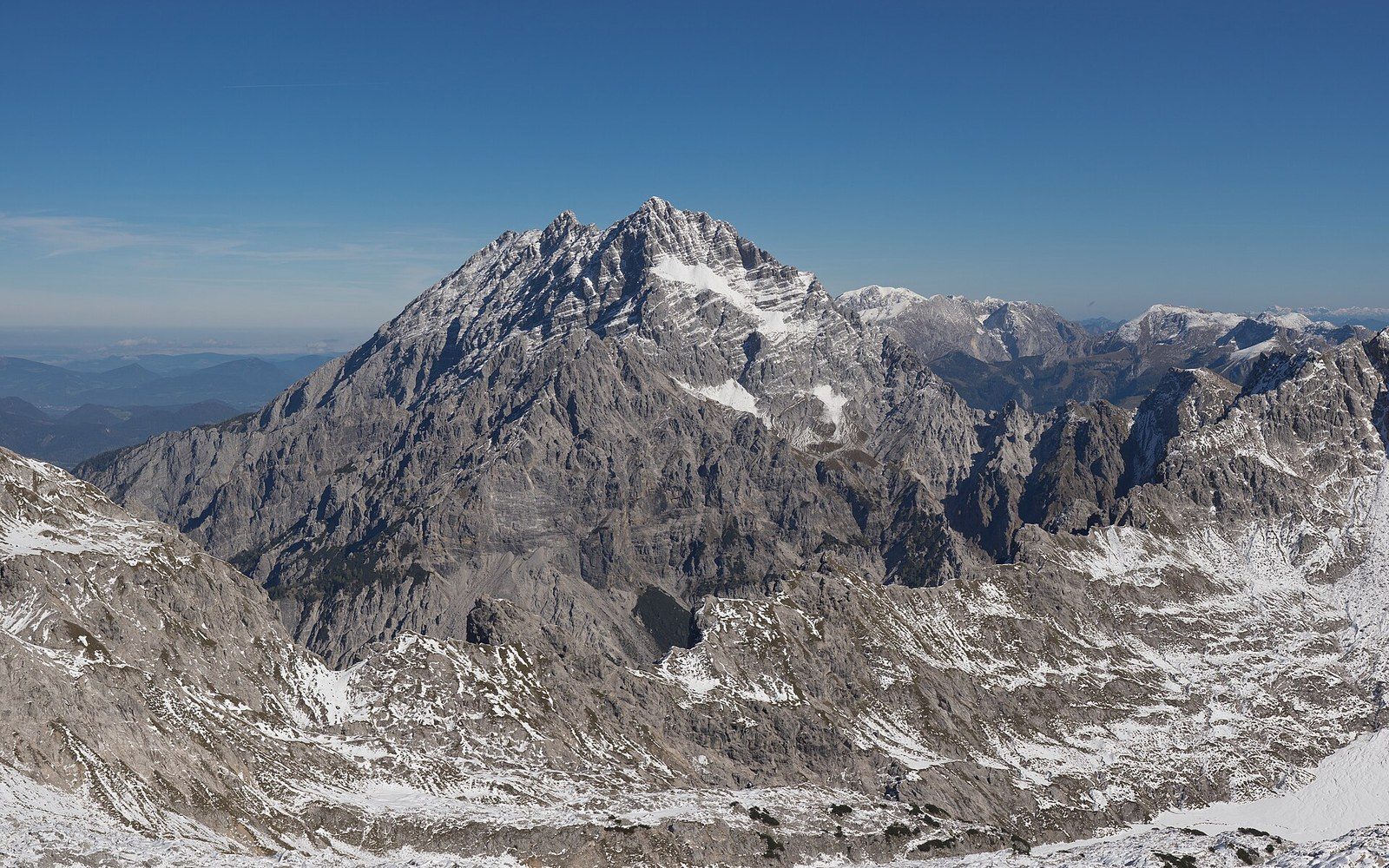
A large rock face above a treeline with cloud crossing itPhoto: Watzmann von Südwesten · Wikimedia Commons
The Watzmann east face is the highest rock face in the Eastern Alps, and the mountain has been spoken about differently ever since someone first measured it.
What the face is
The Watzmann rises immediately south of Berchtesgaden, and from the town you see its western side: a long ridge, broad enough that it reads as a mountain rather than a wall. Turn to the east, or approach from the Königssee — whose western shore the face drops straight into — and you understand why this is a different category of mountain. The east face runs for roughly two thousand metres of vertical relief between the Hocheck summit and the water's edge. No other rock face in the Eastern Alps is as high.
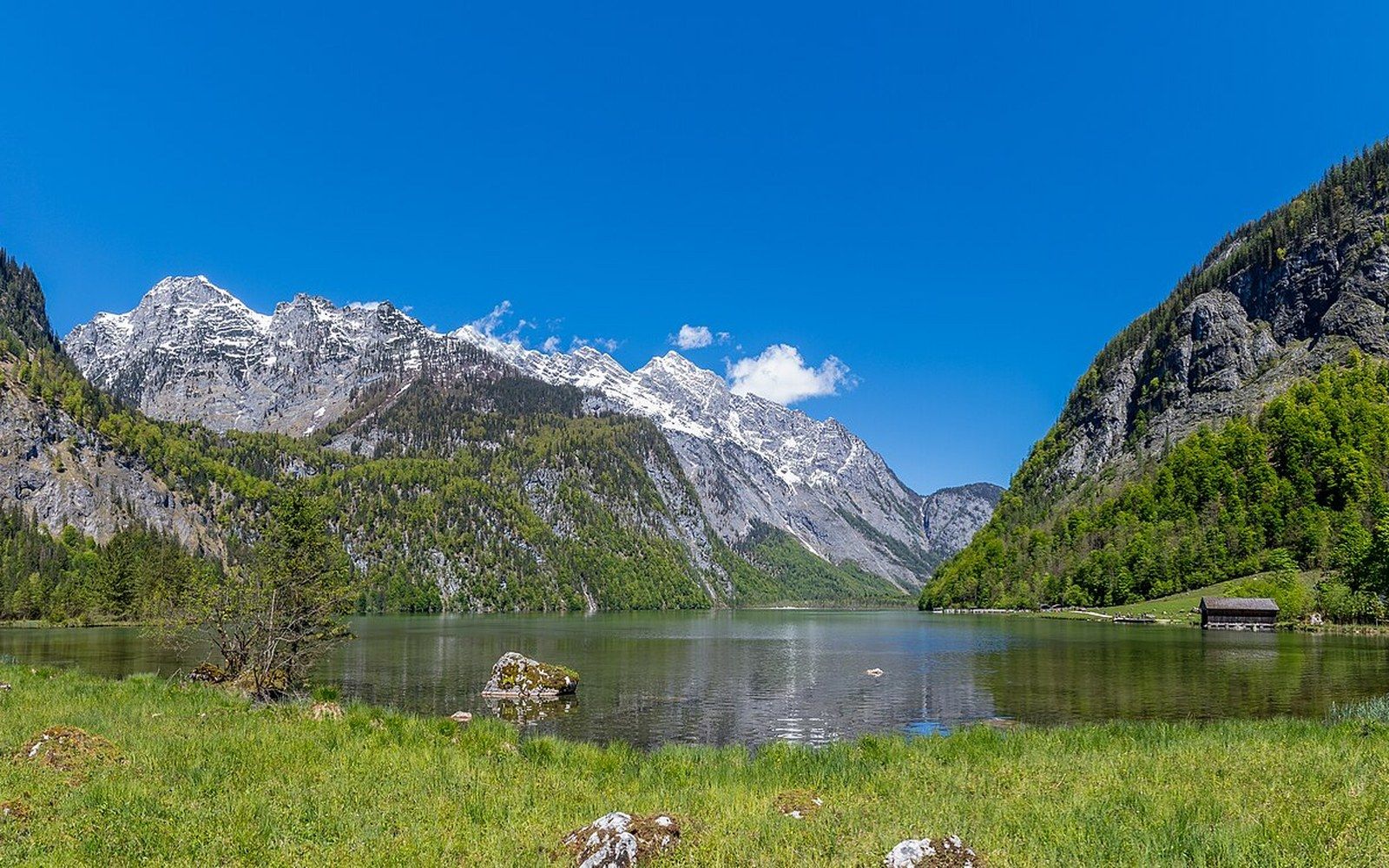
The wall is limestone, the same Berchtesgaden dolomitic limestone ↗ that forms the whole massif, and it is not a clean slab. It is broken into gullies, ledges, ribs and overhangs, carved by ice and water over tens of millions of years out of seabed sediment. Snow collects on those ledges in winter and releases unpredictably. Ice builds and strips back. The lower section above the lake is particularly complex: big, loose, and in places genuinely vertical. The face faces east, which means early morning sun and then shadow — a thermal pattern that drives the mountain weather on that wall in its own way, separate from what is happening on the plateau above.
The Hocheck, Mittelspitze and Südspitze — the three main summits of the massif — are all connected by the Watzmann ridge, and a traverse of all three is an established, serious undertaking in alpine mountaineering. But it is the east face, not the ridge, that gave the mountain its particular weight in the literature of the Alps.
The record it carries
The first recorded ascent of the east face was completed in 1881, by Johann Grill — known as Kederbacher — and Otto Schück. Grill was a chamois hunter and local guide from Ramsau, and his knowledge of the face's terrain, ledge systems and snow conditions was the kind of knowledge that accumulates across years of working on a mountain rather than visiting it. Johann Grill's first ascent ↗ stands as one of the landmark achievements of nineteenth-century alpinism in the limestone Alps.
Since that ascent, the east face has been climbed by many routes and in many conditions, including winter. In winter, the face is a serious mixed and ice climb; in summer, a technically demanding rock route with objective hazards that do not diminish. Because the face is inside the Berchtesgaden National Park ↗ — established in 1978 as Germany's only alpine national park — access is managed and the environment of the face itself is protected. The park boundary runs across the massif, and the national park authority oversees what can and cannot be done on and around it. The lakeshore below the face, on the Königssee, can be reached only by the electric passenger boats that have operated since 1909; no private motor vessel is permitted on the water, a restriction that keeps the acoustic environment of the face's base essentially unchanged.
The east face runs for roughly two thousand metres of vertical relief between the Hocheck summit and the water's edge
The register it produced
A mountain generates a literature when it exceeds what casual observation can account for. The Watzmann's east face did that early, and it has not stopped. It appears in Bavarian folk legend — a story of a cruel king and his family turned to stone, the massif as punishment — which speaks to how long the face has dominated the imaginative landscape of the region, not just the physical one. That is an unusual thing for a piece of rock to achieve.
The face is not a place that is hiked or scrambled. It is guided and roped ground, and even experienced alpinists treat it as an undertaking rather than an outing. What it is, for the person standing on the Königssee shore looking west, is simply the largest wall they are likely to have stood beneath in the Eastern Alps — a structure whose scale reads in the body before the mind has finished calculating it. The Watzmann is a well-mapped, well-described mountain. The east face is why it is also a famous one.