Königssee banned combustion engines in 1909 to preserve echoes
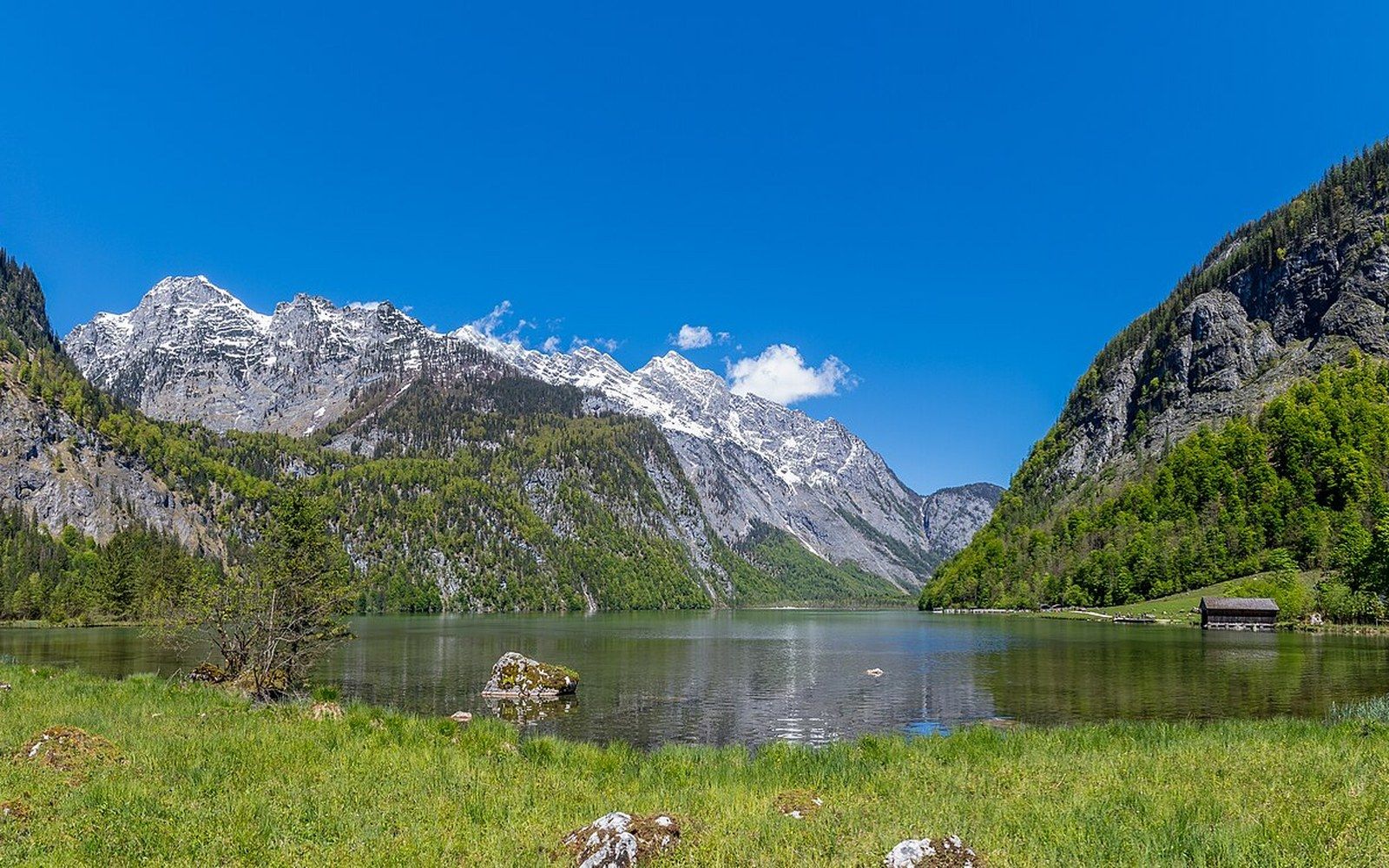
A deep green lake between near-vertical rock walls, a small boat crossing itPhoto: Lago del Rey, Alemania, 2019-05-17, DD 53-57 PAN · Wikimedia Commons
The Königssee is one of the deepest lakes in Germany, ringed by walls the water cannot get around. The boats are electric, the echo is the reason, and you are not allowed to disturb either.
A basin with nowhere to go
The Königssee occupies a trough gouged by ice during the last glacial period, tucked into the southeastern corner of Bavaria near Berchtesgaden. Its sides are not gentle slopes with footpaths running down to the shore — they are near-vertical limestone walls, some rising more than a thousand metres straight out of the water. There is no road around it. There is no path around most of it. You enter from the northern end at the village of Schönau am Königssee and you go south by boat, or not at all.
The water is exceptionally clear and, for the same reason the Eibsee and the other glacially carved lakes of this region carry it, coloured a deep blue-green. Rock flour — the fine mineral suspension ground by glaciers and carried into the basin — scatters shorter wavelengths of light, and the result is a colour that seems lit from underneath rather than reflected from above. The lake is around eight kilometres long, just under two kilometres across at its widest, and reaches depths of nearly 190 metres, which puts most of its volume well below the photic zone: cold, still, and largely oxygen-poor at the bottom.
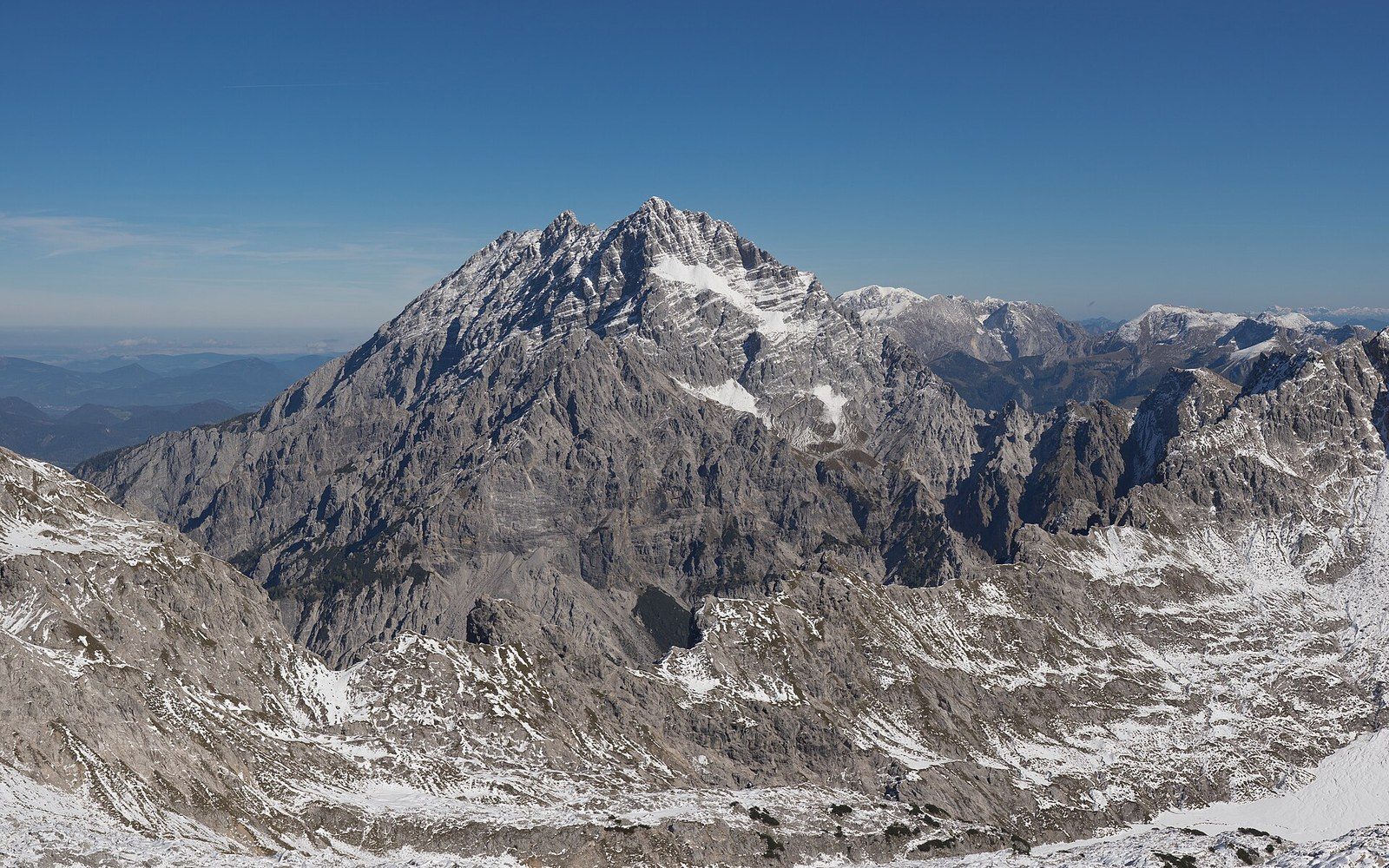
The walls that close it in are the walls of the Berchtesgaden Alps. On the western side, the Watzmann presents its east face — the highest rock face in the Eastern Alps — directly to the water. Sound launched from a boat toward that wall comes back in a few seconds, clean and precise, because there is nothing between the source and two thousand metres of stone. The echo is not a local legend or a tourist embellishment. It is the acoustic consequence of the geometry: flat water, vertical limestone, no vegetation to absorb the return.
Electric since 1909
The Königssee fleet has run on electric motors since 1909, making it one of the earliest electrified passenger boat services in the German-speaking world. The reason stated at the time of conversion was the echo. Internal combustion engines had been tested and found to produce noise that was both intrusive and, from the perspective of the lakeside operators, commercially counterproductive: the echo was already the centrepiece of the passenger experience, demonstrated by a boatman playing a flugelhorn off the stern and letting the Watzmann wall answer. A diesel thrum would compete with it.
The current fleet, built and maintained under strict environmental standards, draws power from shore infrastructure. The Berchtesgaden National Park ↗, established in 1978 and covering around 210 square kilometres of the southeastern Bavarian Alps, prohibits motor vessels on the lake entirely — electric passenger boats are the exception permitted under the national park's own rules, and private motorboats are not allowed. Swimming is possible but the water temperature reflects the depth and the latitude: even in August it rarely climbs past fifteen degrees in the main basin.
- St. Anton
- Eibsee
- Garmisch
- Achensee
- Mayrhofen
- Grossglockner
- Königssee
- Bad Gastein
The boats run from Schönau to St. Bartholomä — the pilgrimage church on a small promontory below the Watzmann east face, its three red onion domes one of the most reproduced images in Bavaria — and from there to the lake's far southern end at Salet. From Salet a short walk reaches the Obersee, a smaller lake in a hanging valley behind a moraine, quieter still and accessible only on foot. The entire southern part of this journey is enclosed: walls on both sides, the water a corridor rather than a lake in any conventional sense.
The flugelhorn demonstration has been performed at the same spot in mid-lake for well over a century. The boatman stops the engine — no great mechanical gesture with an electric motor, just silence — and plays two or three notes toward the western wall. The return comes back layered, the wall reflecting different points simultaneously, so the echo arrives not quite as the note went out but as a slightly smeared version of it. The performance is not scripted by the national park. It has simply survived because it works.
You enter from the northern end at the village of Schönau am Königssee and you go south by boat, or not at all
Inside the park
The Berchtesgaden National Park was designated in 1978 as the only national park in Bavaria and one of the few in Germany to be genuinely alpine in character rather than lowland or coastal. It covers the high limestone massifs, the hanging valleys, the Wimbachklamm — Klamm meaning gorge, a slot cut by a fast stream through soluble rock — and extends up to the ridge lines that form the Austrian border. Management sits with the Bavarian State Ministry, not with the local municipality, which is why the rules on the lake are national park rules and carry the weight of conservation law.
The no-noise convention is reinforced, though not solely created, by that legal framework. Walkers on the few paths that do reach the shoreline are expected not to disturb nesting birds on the cliff faces, and the cliff faces themselves are designated as protected habitat. The peregrine falcon colony on the Watzmann's lower walls is monitored, though precise counts vary year to year and the park authority publishes only general survey data rather than live figures.
Sound, then, is a resource on this lake in a way it is not on lakes where traffic noise already sets the floor. The electric boats do not add to that floor. They move with the low mechanical hum that has been the sound of this service for more than a hundred and fifteen years, a sound that is by now inseparable from the place, and when the engine cuts at the flugelhorn stop it is genuinely quiet in a way that surprises people who have arrived via the car parks, the souvenir shops and the summer crowds at Schönau.
The crowds are real. Schönau am Königssee is one of the most visited natural sites in Bavaria, and the boat jetty in summer operates with queuing systems and timed departures. None of that disappears once you board. What changes is the walls closing in and the road noise stopping, because there is no road to follow the water. By the time the boat reaches the open water south of the first narrows, the park has already taken over from the infrastructure, and the infrastructure is just the boat, the water and whatever the Watzmann has to say back to you.