Bad Gastein built grand hotels vertically around falling water
Tall nineteenth-century hotel facades stacked up a steep gorge with a waterfall between themPhoto: Bad Gastein Waterfall · Wikimedia Commons
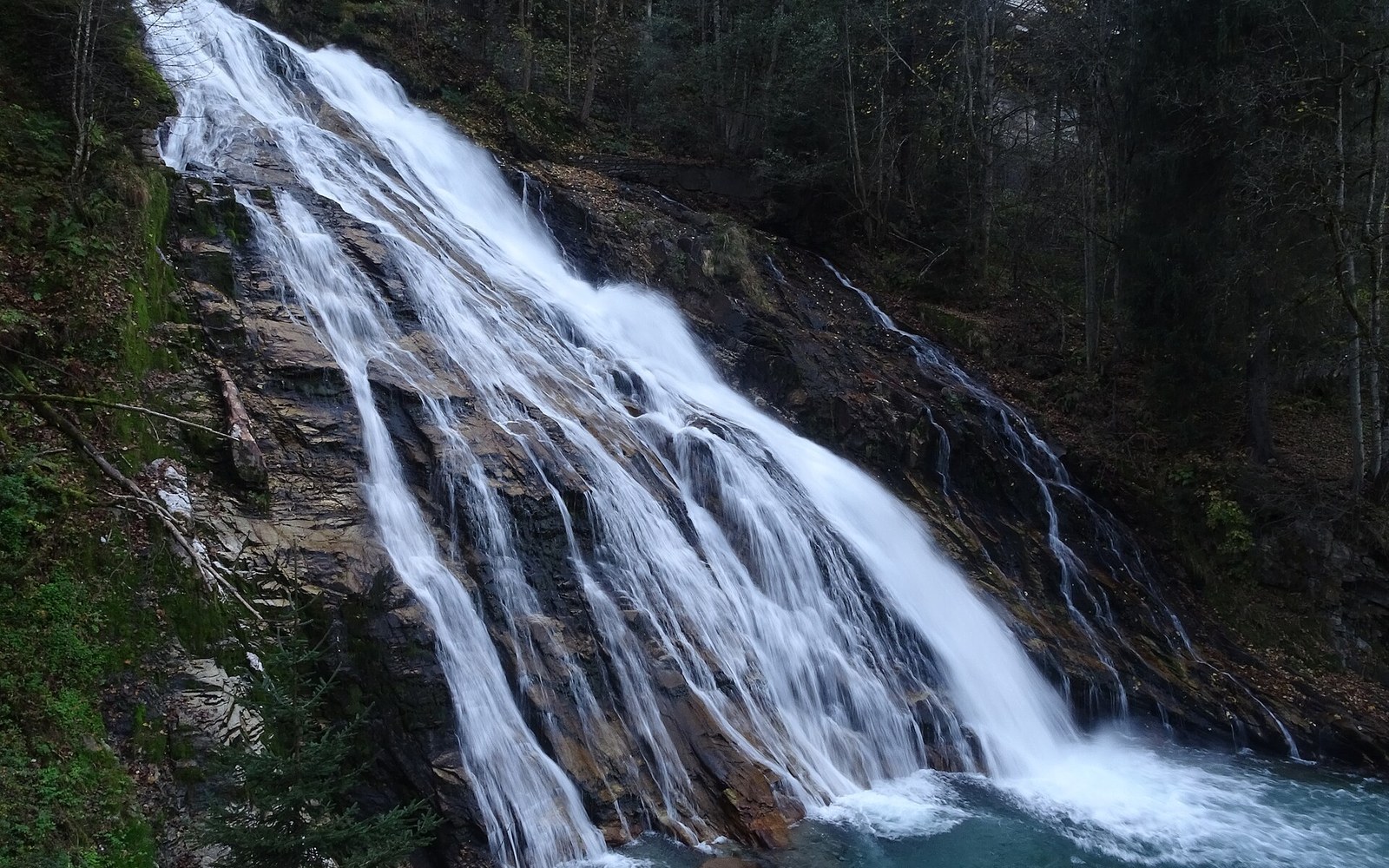
A thermal spa built where a torrent falls: Bad Gastein occupies a ravine in the Hohe Tauern, its grand hotels terraced into the rock face on either side of a cascade that drops through the centre of the town.
Water first, then stone, then guests
The Gasteiner Ache drains a high cirque at the head of the Gastein valley — the Gasteinertal — and at the point where the valley floor suddenly drops, the river falls in two linked cascades totalling around seventy metres. The falls did not just attract a town; they determined its form. There was no flat ground on which to spread. Hotels had to climb the walls of the ravine, tier upon tier, and the cascade runs between them so that from almost any window you either see the white water or hear it. The result is unlike anything else in the Alps: a grand-hotel streetscape that is essentially vertical, with roads and footbridges stitching levels together across the noise.
The thermal water is the reason anyone arrived at all. Springs in the surrounding rock issue water at temperatures between roughly forty and forty-seven degrees Celsius, and the water is mildly radon-bearing. By the early nineteenth century this combination had made Bad Gastein — then simply Gastein — one of the most fashionable medical destinations in the German-speaking world. Emperor Franz Joseph visited repeatedly from the 1850s onward, and the Habsburg court's patronage worked on the town the way a key turns a lock: once the emperor came, the financiers and the architects arrived, and the ravine walls filled with stone.
What was built and when
The construction logic followed the spa cure rather than any conventional resort pattern. Guests came to drink and bathe, to walk on prescribed promenades, and to rest in a landscape the medical profession of the day considered restorative. The architecture answered those expectations with some directness. Hotels were large — large enough to accommodate not guests passing through but guests staying for weeks — and they were built in the language of Ringstrasse Vienna: rendered facades, arched windows, wrought-iron balconies and mansard roofs. The thermal baths themselves were incorporated into the town plan as civic buildings, centrally positioned, and the promenades — some of them cantilevered over the gorge — were engineered as pieces of public infrastructure rather than afterthoughts.
The Tauern main line was complete by 1909, placing Bad Gastein on a direct connection to Vienna and, eventually, to the Italian Adriatic coast. The station sits below the town, because there was nowhere else to put it. From the platform, guests were transferred upward through a town that only becomes comprehensible as you climb it: each level wider than you expect, each turning revealing another hotel above. The Straubinger, the Weismayr, the Elisabethpark — these are not names from a brochure; they are buildings that have been standing in the gorge for more than a century, and their facades have accumulated repairs, additions and the particular gravity that comes with that kind of duration.
The Hohe Tauern National Park, established in stages between 1981 and 1991, now surrounds the Gasteinertal on three sides. The high ground above Bad Gastein — the Graukogel, the ridgeline toward the Stubnerkogel — lies within or immediately adjacent to the protected zone. This did not so much change the character of the town as set a boundary around its expansion. The valley bottom is the spa; above it, the national park holds the land.
- St. Anton
- Eibsee
- Garmisch
- Achensee
- Mayrhofen
- Grossglockner
- Königssee
- Bad Gastein
The radon question and the physics of the water
The thermal springs of Gastein have been the subject of scientific interest since at least the early nineteenth century. The water's slight radioactivity was identified in the early twentieth century and, from around the 1930s onward, became the basis of a therapeutic claim that attracted patients with rheumatic and joint conditions. The Heilstollen — a former gold mine above Böckstein, at the valley's southern end — was repurposed into a radon inhalation gallery, which is a different thing from the thermal baths: visitors lie in trolleys that are winched into a tunnel where both temperature and radon concentration are elevated. Radon in the context of therapeutic exposure ↗ sits at an unresolved point between regulated medicine and contested balneology, and different national health systems have taken markedly different positions on its status.
The falls did not just attract a town; they determined its form
The thermal water itself arrives from depth at consistent temperatures regardless of season. The springs are connected to a district heating system that, by the mid-twentieth century, was supplementing or replacing conventional fuel heating for many of the hotels. The falls, meanwhile, generate hydroelectric power — the cascade that runs through the hotel facades is also, at its base, a working part of the valley's energy infrastructure. Water that falls through the heart of one of the Alps' most theatrical hotel townscapes is simultaneously moving electrons out of the gorge and into the grid.
The town's vertical grammar
To walk Bad Gastein from its lowest streets to its highest is to move through several decades of building at once, because the ravine walls were filled sequentially as demand grew and money arrived. The lowest level, closest to the river and the noise, was generally for service infrastructure: the laundry, the delivery roads, the power equipment. The spa buildings and the grandest hotels claimed the middle levels, where the falls are most visible and the footbridges span the gorge at their most dramatic. Above that, on terraces cut into the slope or built out from it on retaining walls, the sanatorium-style buildings appeared from the early twentieth century onward — long facades with south-facing balconies calibrated for sun and air, built for the extended-stay cure rather than the social season.
The Österreichischer Alpenverein ↗ maintains huts and marked paths in the high ground above the valley. The Gasteiner Hütte and other staffed points in the surrounding cirques connect the spa town at the bottom to a genuine high-alpine network above, and the contrast is abrupt: within an hour's walking from a hotel with a marble lobby and a thermal pool, the terrain is boulder field and late-season snow.
What gives the town its particular atmosphere — beyond the falls and the facades — is a kind of structural honesty that it did not choose. The ravine imposed itself. No urban planner decided to build hotels around a waterfall; the waterfall was there and the hotels had to work around it, above it, and in earshot of it through every season. The result is a town that was shaped by geology more directly than most, and whose grandeur is therefore always slightly off-balance — the elegant stonework in one frame, the raw falling water in the next. Visitors who come expecting the measured calm of a flat-ground spa find something noisier and stranger and, on most counts, more memorable than that.