Kaprun reservoirs began in 1938 under forced labour
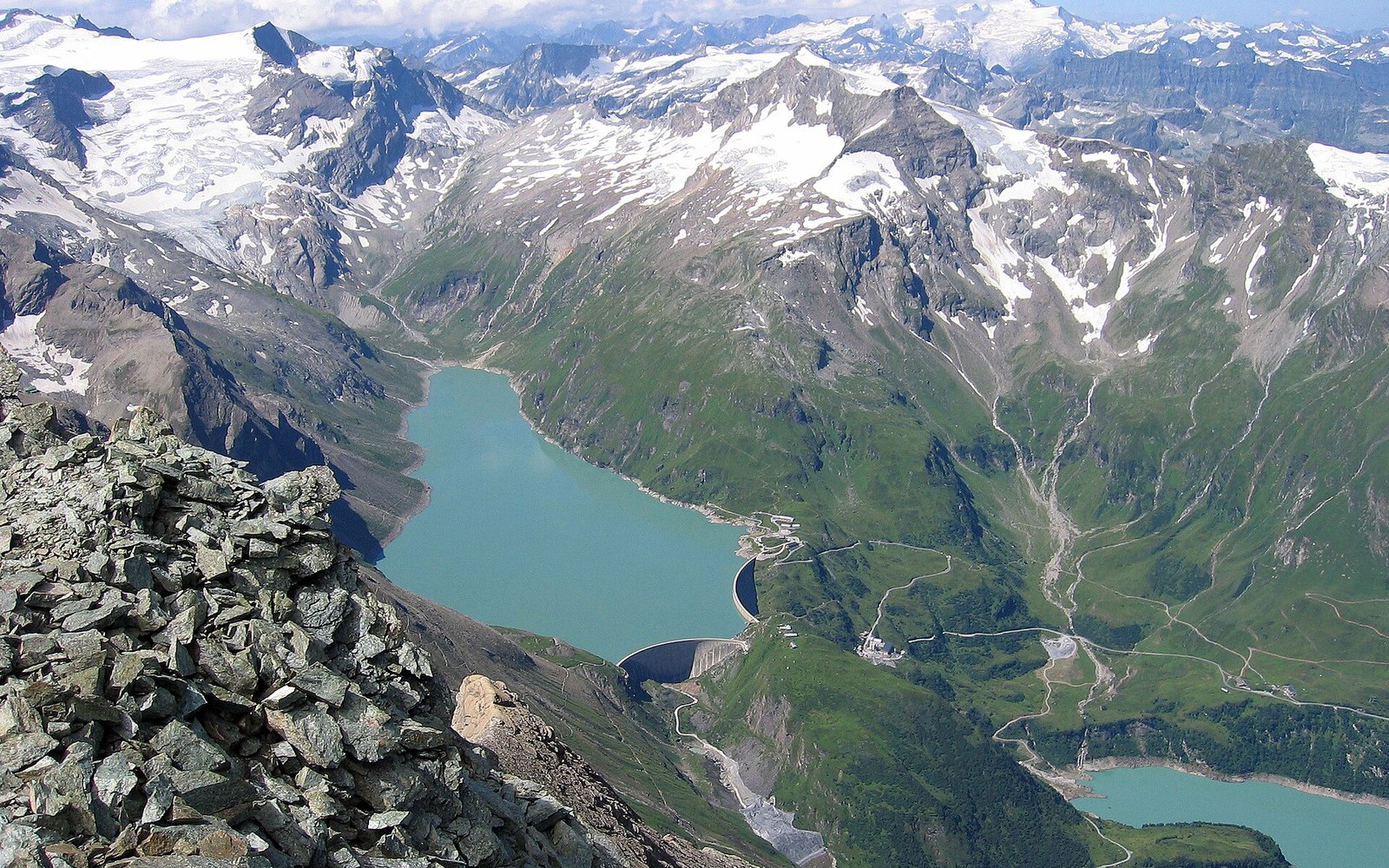
A dam wall curving between rock shoulders with a reservoir behind itPhoto: StauseeMooserboden · Wikimedia Commons
Rock, water, and a valley's worth of concrete: the Kaprun high-mountain reservoirs were begun in the ruins of one era and finished in another, and the turbines beneath them have run ever since.
The idea before the war
The Glockner-Kaprun hydroelectric scheme had been on paper since the 1920s. Austrian engineers recognised that the glaciated valleys above Kaprun — the Kapruner Tal running south toward the Grossglockner road massif — held an unusual combination: high snowfall, reliable melt, and a valley floor low enough to create significant hydraulic head. The state utility Tauernkraftwerke AG was founded to build it. Then the Depression arrived, and the project stalled.
German occupation changed the timeline brutally. The Reich needed aluminium smelting capacity, which needed electricity, and Kaprun was reopened as a war-priority construction site in 1938. Thousands of forced and conscripted labourers worked the high sites; the conditions were lethal and the records of those who died there are held by Austrian memorial institutions. By 1944 the valley-floor infrastructure and some of the lower tunnels existed, but no reservoir held water.
What they actually built
After 1945 the new Austrian republic inherited the works and inherited the debt. Marshall Plan funds helped restart construction from 1947, and the project became what official accounts of the period called a Wiederaufbau — a rebuilding — that was also a proof of national capacity. The Hohe Tauern National Park ↗ authority did not yet exist; the landscape was then open to engineering at an altitude that would today require a different kind of negotiation.
The upper reservoir, Mooserboden, sits at around 2,036 metres. The lower, Wasserfallboden, is separated from it by a short section of mountain and lies around 1,672 metres. Together they are impounded by three concrete arch-gravity dams — the Moosersperre, the Drossen dam on the Wasserfallboden, and the Limberg dam lower down — whose combined concrete volume is measured in millions of cubic metres. The Moosersperre dam, completed in 1955, is the most photographed of the three: two curved white walls meeting at the mountain's shoulder, each about 107 metres high, holding back a reservoir that fills from snowmelt across a catchment stretching toward the main alpine divide.
The powerhouse, bored into the rock below the valley floor, came online in stages. The first turbines generated power in 1955; the full installation took until the early 1960s to reach design capacity. At that point the Glockner-Kaprun scheme was the largest hydroelectric installation in Austria and one of the largest in the Eastern Alps. Its installed capacity, as documented by Verbund AG — the utility that eventually absorbed Tauernkraftwerke — runs to several hundred megawatts across the combined stations.
The state utility Tauernkraftwerke AG was founded to build it
Getting up to see it
A funicular railway and an inclined lift system, built during the construction decades, carry visitors from the valley station at Kesselfall up through the mountain to the reservoir level. This infrastructure was originally workers' transport: the tunnels are undecorated and the gradients are the gradients engineers chose, not tourism architects. At the upper station the view across the Mooserboden — grey water, white arc of dam, the glaciers of the Hohe Tauern retreating on every skyline — is one of the more striking industrial landscapes in the Austrian Alps.
The Hohe Tauern National Park ↗, established in stages between 1981 and 1991, now surrounds the reservoir zone. The dams themselves predate the park by decades and are therefore operating infrastructure within a protected landscape — an arrangement that sits awkwardly in principle and functions smoothly in practice, because the reservoirs have been full for sixty years and the construction crews are long gone.
What the visitor stands in is genuinely dual: a national park whose glaciers are among the best-studied retreat sequences in the Alps, and a working power scheme whose water turns the turbines when Austria's demand peaks on a winter evening. Both things are true at once, and the dams make no apology for it. They were built at a particular cost, in a particular decade, for reasons that outlasted the politics that originally drove them — and the turbines are still running.