1884 turned Vorarlberg's winter barrier into year-round artery
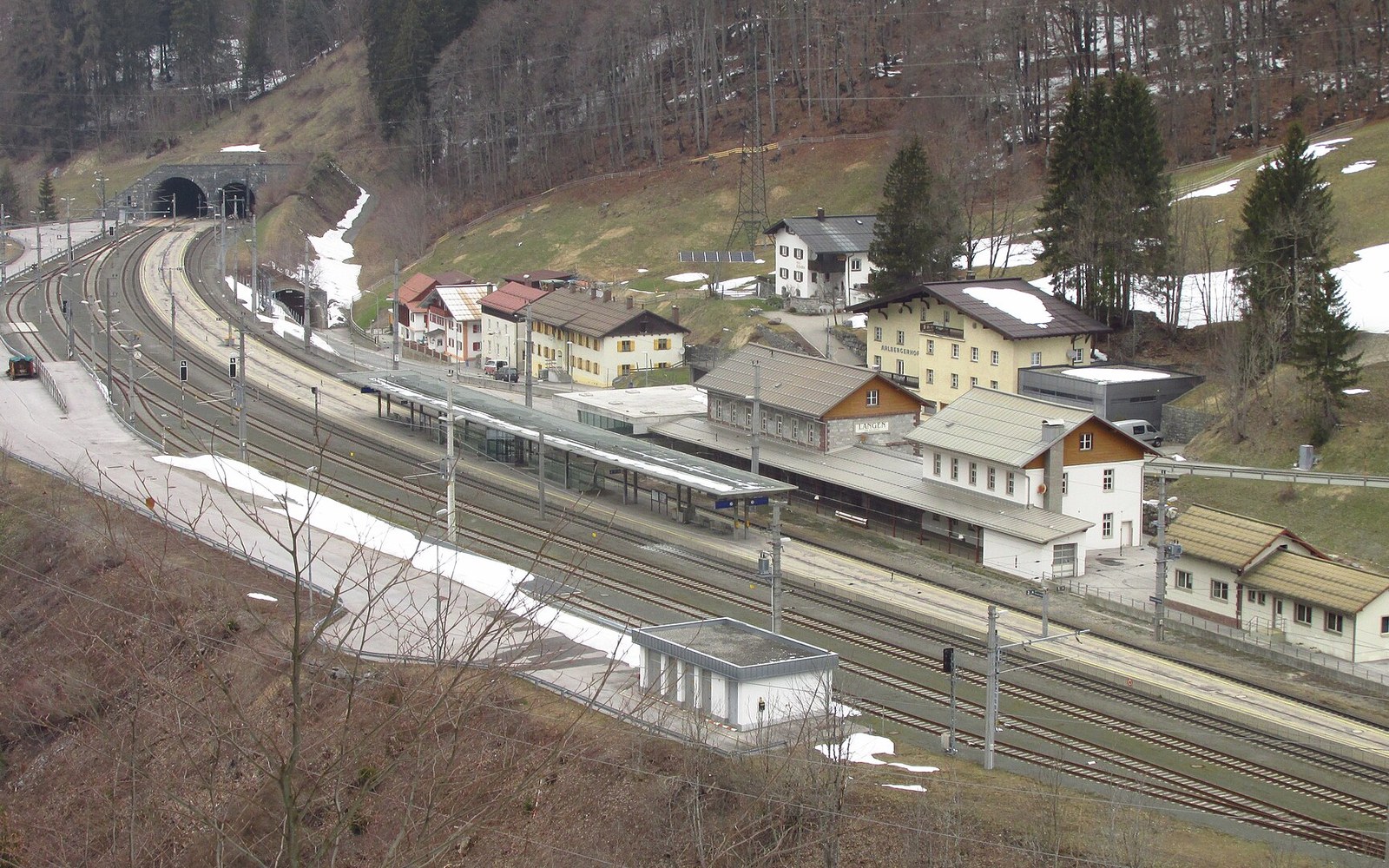
The tunnel portal with a railway worker walking the platform, snow banked against the fencePhoto: Bhf Langen am Arlberg · Wikimedia Commons
Langen am Arlberg is where the tunnel begins — or ends, depending on which way the train is running — and the fact that most passengers barely notice it says everything about what it actually did.
What the tunnel changed
The Arlberg railway tunnel opened in September 1884, bored through ten kilometres of limestone and crystalline rock beneath the pass at roughly 1,300 metres. Before it opened, the Arlberg was a seasonal barrier. The pass road iced over, coaches stopped, and the Vorarlberg — Austria's westernmost province — spent its winters effectively cut off from Vienna. The tunnel ended that. Langen am Arlberg ↗ sits at the western portal, where the single-track bore emerges from the mountain and the gradient eases into the Rhine valley.
The construction was overseen by engineer Karl von Etzel's successor teams after his death, and the actual tunnelling fell to Julius Lott and later Carl von Ruppert — four years of rock work, often through hard gneiss and running water. At ten kilometres, it was one of the longest railway tunnels in the world at the time of its completion, and it drew the Arlberg into the central European railway network in a way that the summer road could never have achieved alone. Passenger services began in 1884; freight followed, and the railway became the artery that kept the whole corridor alive through winter.
What the tunnel gave the Arlberg was not tourism first — that came later — but a working year. Coal, timber, livestock and post moved through in both directions. The villages east of the tunnel, strung along the valley toward St. Anton, had been mountain communities whose surplus was measured in weeks. The railway stretched that margin.
The village and the trains
Langen itself is small and was always small. Its function was infrastructural: a halt, a freight siding, a place where passengers changed their bearings. The station building stands close to the portal, and the operational logic of the place has barely shifted — trains still pause, still take on or set down, still disappear into the mountain going east.
The Arlberg line runs from Bludenz in the west through Langen, beneath the pass, and down through St. Anton to Landeck and on to Innsbruck. The Austrian Federal Railways, ÖBB, operate it now as part of the main west corridor between Vienna and Bregenz, and modern traction has condensed what was once a laborious gradient into a commute. But the engineering that makes that ordinary journey possible was not ordinary when it was built. The approach grades on the eastern side, above St. Anton, required steep adhesion-worked ramps that preceded the line's electrification — the line was progressive and contested at every kilometre of altitude.
The pass road iced over, coaches stopped, and the Vorarlberg — Austria's westernmost province — spent its winters effectively cut off from Vienna
Langen's other claim is the road that did not come first. The Arlberg pass road — the route threading through St. Christoph and down to Stuben — was only completed in its modern form decades later, and the Flexen road that connects the Lech valley above Stuben is a late-1890s construction requiring galleries and snowsheds to stay open at all. The tunnel preceded all of it and made the region reachable in winter when nothing on the surface could.
What stands at the portal
Come into Langen by train from the west and you arrive at a standard mountain halt — short platform, wooded hillside, the portal mouth in the rock face. What is not visible is the years of navvy labour, the water pumping, the drilling in compressed air and candlelight that produced those ten kilometres of void. The portal is a plain concrete arch now, tidied and maintained, and the trains enter it with the efficiency of a thing whose purpose has long since been absorbed into the ordinary.
That is the real mark of the tunnel's success. Langen sits at its mouth and the place is quiet, because the connection it provides is so complete that nobody needs to stop and think about it. The Arlberg was locked. The bore was cut. The lock has not closed again.